The Evolutionary Purpose of Human Sexuality

Why do we have sex? Why do human beings put so much effort into having it? The basic answer would be because it feels pleasurable. Yes, that is true, sex can be quite a pleasurable sensation, but there are many pleasurable things like eating a piece of chocolate or getting a nice soothing massage, yet we don’t put anywhere near the amount of time and effort into doing these things as we do towards having sex. Another answer is for the purpose of reproduction, but with the plethora of birth control oppositions (birth control pills, condoms, etc) is that really a viable reason why most people have for having sex, particularly in the Western world?

What is the purpose of sex? easy enough to answer. It is the mechanism that organisms use to propagate their genes into the next generation(well, at least half), and why do organisms(multicellular organisms such as mammals, fish, and birds) use this method? Well, some have theorized that it helps bolster their progenies’ immune system by having shared its genetic information from two genetically distinct parents. Current theories place the emergence of sex around five hundred million years ago.

All life’s purpose on this planet is to reproduce( as nihilistic as that sounds), and it is no different for humans. Our urge to have sex is a by-product of millions of years of evolutionary history. Our ability to discriminate between sexual partners under the guise of physical attraction is also a by-product of our evolutionary history. Physically attractive people are supposed to have a good immune system so the theory goes.

And what about the differences between the sexes when it comes to their attitudes about. Anyone who has dealings with both men and women would discover their attitudes towards sex are decisively different. Men are more prone to sexual escapades and seem to be less discriminatory when it comes to who they have sex with. Women are generally more coy. This makes sense when you realize the two sexes don’t share the same burden when it comes to sex, i.e, women get pregnant and will take the brunt of the child rearing, so it makes sense for them to be the more prejudiced who they copulate with. Men, on the other hand, are programmed to have sex with as many partners as possible(if they actually choose to do this, it is their own choice, of course). Need proof on how promiscuous men can be, gay men are a perfect example, their ability to have sometimes hundreds of sexual partners is because of course, because they are not inhibited by women’s natural coyness.

So, back to my original argument on why to have sex. To be more emotionally attached to somebody, a reasonable argument, your brain releases certain chemicals that almost make you more attached to the person you are having sex with(evidence suggests this is more true for women than it is for men), but a lot of people hook up all the time, sometimes even having one-night stands. Can you really be emotionally attached to a person you are minimally familiar with, and what about the countless women who give up their bodies to alpha males(i.e, athletes, rappers, politicians, and other men of stature), can you really say these women love these men, perhaps on a very superficial level?

Humans’ potency to have sex is nothing more than just evolutionary mechanisms put in place to make sure we are acting on evolutionary obligations to propagate genes into the next generation.


Understanding Homelessness in NYC: Myths and Realities

Living in New York City, as is the case in any major city throughout the world, one of the many daily occurrences you encounter is that of homelessness. As I walk into the subway and sit down, I expect some person claiming to be homeless and needing some help. I actually see the same person sometimes multiple times a week asking for money. I used to be pretty generous and give money to the homeless(especially if they had a visible handicap), but then one day I asked myself a question about why there were so many people who were homeless and what policy could be put into place to really address the problem.

First and foremost, homelessness, particularly in NYC, gets over-exaggerated. About less the one percent of New Yorkers are homeless. And to further break the number down, most homeless people suffer from either substance abuse or mental illness, which inhibits them from carrying out basic life necessities such as holding a steady job or maintaining basic hygiene. If you want to alleviate homelessness, more mental health hospitals and fewer shelters would prove much more effective. Now can we go around and put every homeless person who we suspect to be crazy and rush them to a mental institution no( at least not exactly) It would best be done through a system where a homeless person breaks a law such as public urination or vagrancy and having a psychiatrist do an evaluation to see if that person is susceptible to go into society and of course getting the person to consent to be institutionalized (unless the person is deemed a danger to himself or others and such consent wouldn’t be needed).

And second, the idea that I am going to give every homeless person who asks me for money throughout my day my hard-earned cash to encourage them further to beg doesn’t help anybody. It came to me one day that many homeless people actually are already receiving government assistance through disability and SSI checks that they beg because they know they can get over on people. A typical New York City subway train contains ten cars. So if you were homeless and ambitious enough to beg for money on every subway car and get at least two people to give you a dollar, you can earn twenty dollars per train. You hit five trains in a day, you can make up to a hundred dollars a day just begging for money(untaxed, mind you). So homelessness for some can be pretty lucrative.

If you don’t buy my point, look at how the Japanese deal with their homeless issues. Which can best be explained by watching this video https://www.youtube.com/watch?v=eK–oCVP18A. I myself had gotten a chance to visit Tokyo a few years back and was struck by how different homelessness was over there than it is here. First, no homeless person can ever be seen begging. Second, I didn’t encounter any homeless person who reeked of foul odor, as is the case in NYC(whole subway carts will be emptied just because passengers can’t take the smell of some of the homeless people in it). The third most homeless people live in these makeshift communities in the Tokyo subway systems.

I do believe that we should help people who are down on their luck for their sake and ours, but I just think we’re going the wrong way about it. And that by having an honest and more open dialogue, we’ll really help these downtrodden individuals.

Debating the Role of Prisons in Modern Society

Recently, I had a few debates with several people about the relevance of prisons. Whether or not prisons where an appropriate form of punishment in our modern times. The opposing view was that prisons did more harm than good, by further indoctrinating people into crime, or that prisons permanently hinder people from ever fully entering mainstream society after they are released. Of course, many people who hold an anti-prison viewpoint don’t give an alternative to prisons, or when they do, it’s a vague answer, such as rehabilitation, without giving details on how this rehabilitation would be administered.

I am not at all condoning our justice system. There are certainly many ways in which it can be approved. It is particularly audacious that the United States has less than five percent of the global population but holds about twenty-five percent of its prison population. So I say the problem isn’t necessarily prisons, but the fact that we have too many people in prisons and that one particular ethnic group is overly represented among that prison population. 

I wholeheartedly believe that many offenses that warrant prison sentences today are unjust. Such as drug offenses, which on the surface is a victimless crime since it involves two consenting parties, the drug dealer and the purchaser of the drug. I also believe crimes like tax evasion and failure to pay child support shouldn’t warrant prison time since it does more bad than good by having society pay for the maintenance of offenders who essentially didn’t pay society in the first place, an unusual sense of justice if one truly thinks about it.

To run any modern society, you need to establish a government with an effective rule of law. The government must have some coercive power to make sure all its populace abides its laws. How do you deter people from engaging in crime? By establishing punitive retribution for anyone who breaks the law. The most popular form of such a retribution in all nations is a prison system. In prehistoric human societies, humans probably carried out punishment on an offender in three ways. The first was in a form of payment to the offending party through cattle, tools, or involuntary servitude; the second would be in exclusion from the clan, or in other words, being permanently banned from the group; the third would have been death.

All three are used today in a modified form, the first through fines that one would pay( usually as tickets for a minor offense); The second would be imprisonment, which is essentially separating someone from everyone else, and the third (although not very common among industrialized nations) is the death penalty.

Many would argue that prison acts as a conditioning for criminals, but has that to do with the prison are the innate conditions of the prisoner himself. Among people, there are just bad apples; some people are naturally more aggressive, more impulsive, and less able to use foresight in their decisions as compared to others. Coupled with an unsavory environment leaves some prone to criminality, and of course, leaves the rest of us with the difficult decision of the best way to deal with said crime.

Of course, I am not arguing against any imposition of reform. I feel as if reform is important, particularly in the case of minor offenders. But this should be available as an opposition for prisoners and not so much a requirement. First and foremost, prisons are meant as punishment and should be seen as such; consequences are the best deterrent to ill behavior. Still, access to some reformatory programs would be good for both the inmate and society. Programs such as skill training or educational opportunities would help inmates reintegrate into mainstream society after being released from prison.

In point, to truly argue against prisons, you have to come up with a system that both keeps society safe and can address how to reduce crime.


Challenging Masculinity in the Black Community

On an early bus ride to work one cold morning, I had a conversation with an old drunkard. The conversation began when he had made a remark about the book I was reading, which happened to be the “Souls of Black Folk” by W.E.B. Dubois. He remarked how I was reading an essential book, to paraphrase him 

“ The black man is lost…..the black man isn’t the gangsta…..the white man is the real gangsta….the black man is weak…you see how they emasculate the black by having him wear dresses and these kids think it’s cool…. The black woman doesn’t respect the black man(as he was saying this, he pointed to two black female passengers who were in front of us). He spoke on until his stop.

This brief conversation left an impression on me. Everything this drunkard old man said was nothing I haven’t particularly heard before, spurted out particularly by older black men. I must say that some aspects of his brief speech I actually agree with.

Chiefly, that the black man is emasculated. But his emasculation has nothing to do with black men being depicted as being gay or wearing a dress, but is because the black man in this country holds no power.  A brief definition of masculinity states “possession of the qualities traditionally associated with men”. This is, of course, an expansive definition, leaving room for many interpretations. However, masculinity is generally associated with power. Now, let’s define power (in the noun sense). In a quick Google search, I have come upon two definitions. First, “the ability to do something or act in a particular way, especially as a faculty or quality”, second, “the capacity or ability to direct or influence the behavior of others or the course of events”.

Is the black man in this country in possession of either definition? I am particularly interested in the second definition as it is pertinent to my argument. When asking yourself, who are the most powerful people in the world, what comes to mind? For most people, it might be a political leader or a business magnate, two groups that exemplify the second definition to the fullest. Now, consider your typical political or business leader. What else comes to mind? Generally, men who wear suits, who are well spoken, and who possess great intelligence. Men in these positions are not your general ideals of urban masculinity. They are generally not physically imposing or brash in their speech, yet they hold considerable power in any modern society.

Now, when you begin to think of the race associated with these types of men, it generally tends to be white (i.e, Bill Gates, Donald Trump, Elon Musk). Of course, there are notable exceptions(Barack Obama, Jay-Z), but in general, we see the men with all the real power in our society as white men.

In Urban culture, masculinity is heavily associated with gangsterism( the exhibition of gangsta behavior,  promiscuity with many women, and the ability to murder other men with little remorse), This is something I have encountered many times myself as a black man who grew up in South Jamaica, Queens, NY. Your entire identity is based on not being deemed soft and earning the respect of your peers through acts of violence. OF course, this isn’t exclusive among inner city blacks( I can think of Machismo in Latin America as an outward example), but this is dangerously pervasive in the black community among black males.

I believe the contemporary understanding of what it means to be a man in the black community leads to violence in the inner city, the sexual objectification of black women, and the pervasiveness of homophobia in the black community. I believe that as black men we need to question what it really means to be a man, and if that definition is holding us back from achieving true masculinity, i.e, power.

The Impact of Instagram on Self-Image: A Critical Look

As I scroll through my Instagram feed, I can’t help but notice similar patterns appearing. Mainly, people(particularly females) are posting relentless selfies. It dawns on me then that Instagram was just a place for people to feel as if they are important, as if a hundred million other people haven’t posted the same type of picture. I see nothing but pretty girls amassing tens of thousands, sometimes millions of followers for nothing other than being pretty. By the luck of a genetic lottery, you can have thousands of people all over the world follow and take an interest in your daily life.

It becomes as if some people live their lives for social media. Going on trips just to brag about where they went later on Facebook. Going out to fancy restaurants just to take a picture of their meal. Posting how depressed they are to gain sympathy from their virtual friends. It becomes quite disgusting in many aspects. This has become such a big business that people literally make a living from posting on social media. Companies will penny out a lot of many for Kylie Jenner’s seventy million Instagram followers. So it becomes profitable for her to endlessly post pictures of the “glorious life” she lives; her famous friends, extravagant parties, and trips to faraway getaways all make her extra rich.

Social media has become a place to feed upon essential human needs, first is to gossip, and second is to satiate the feeling of boredom. We as humans are naturally nosy and want to know what our neighbors are doing, so we scroll through their news feed, pry into their photos, and see what friends we share. Second, in this passive digital time, we are constantly seeking an avenue to pass the time. As Heidegger pointed out, boredom is the acknowledgment that time is passing. If your job is unstimulating, you have your phone and scroll through  Instagram. But is social media the best way to learn from each other, or the most constructive use of our free time? The answer to both these questions is probably no!

According to recent studies, prolonged use of social media increases your chances of depression. Why is this? Because people feel their lives are inadequate compared to others they see on Instagram and Facebook. But what they don’t realize is that people don’t show the “nitty gritty” side of their lives on Facebook (unless, of course, to gain sympathy from a depressing post). People generally curate their lives on the internet.

I wonder constantly if people do this just to feel good about themselves. Those Brittany post a photo of herself in a bikini just to gain approval from her followers? Does John post about his recent promotion to gain flags of congratulations? These internet celebrities essentially do nothing but indirectly brag about how much better their lives are compared to everyone else, and people just passively feed into this virtual game of appraisement

I myself use social media and do fall trap of everything I bear onto this post. I have at times taken a hiatus from Facebook and have generally felt much better for it. I only use Facebook or Instagram as a way to promote any of my endeavors. This being said, there are legitimate benefits to social media, whether it be promoting a product or service, getting an important message out, or keeping in touch with far-away friends and relatives. The question is, what are you using it for?

The Entertainment Dilemma: Black Success in White Markets

Black America has become white America’s source of entertainment. At a glance, a list of the richest African Americans, I noticed an alarming trend. Here is a link to the list so you can see for yourself: “http://www.ranker.com/list/the-20-richest-african-americans/worlds-richest-people-lists

Have you figured it out? Basically, with the exception of a few, nearly everyone on the list are entertainer of some sort. Whether it be sport, music, or film.

Now look at a list of the richest Americans in general, “http://www.forbes.com/forbes-400/top20/#3df0ffc3d8d5”, not one person is an entertainer; the list is made primarily of tech entrepreneurs, energy tycoons, and media moguls.

Black people have been “chucking and jiving” for white America since the minstrels of the 19th century. The only difference today is the market reach and the profitability. Many African Americans take great pride that black people have an influence on pop culture, but at what cost? Have black people become so ghettoized in how they aspire to be successful in this country?

Go to any urban school in this country and ask the typical black child what he or she aspires to be, and the most popular answer is either a sports athlete or a rapper. You will be hard-pressed to hear a child aspire to be a tech entrepreneur or business mogul. Why do young black people have such a limited scope of career choices? The answer lies in what black youth see in the media. The media is very important in how people view themselves. Films, music, television, etc., inform us on how to think, how to behave, and how to view life. When you’re black, you are particularly sensitive to media influence. This is because, as a minority, you have limited exposure to representation that you can relate to, and when you do get that representation, it holds a lot of sway on your thought process.

The worst of this is that black Americans don’t even fully profit from their talents; behind every multimillionaire black entertainer, there is a much richer white person in the background profiting handsomely from black ingenuity. Yes, Michael Jordan became a billionaire from his signature sneaker, but Nike, in return, became a multi-billion-dollar sportswear company with a near-monopolistic hold in their industry. Yeah, rappers make millions of dollars from tours and single sales, but record companies make billions of dollars every year in licensing royalties.

Black America epitomizes cool in this country, and corporations gladly use us as marketing tools, finding an athlete to petals their sneakers, rappers to wear their clothing, or appear in their soda commercials. I’m not at all angry at anybody for profiting off their marketability, but I do just want to fully analyze the situation in terms of race in this country.

We, as black people, need to do better for ourselves; we need to teach our children to have a diversity of aspirations. You have a lot better chance of becoming an oral surgeon or an electrical engineer than a rapper or an athlete. It is vital for the future of Black America that our youth have realistic aspirations.

Why Black America need a conservative revolution!!!

I know many black people took the victory of Donald Trump very hard, but I would like to suggest that maybe such a victory isn’t necessarily a bad thing. Black people in this country(certainly not all) are content with receiving government handouts. A Trump victory was seen as a sign of a reduction in public housing, food stamps, and Medicaid. My issue with this is how so many black people become so reliant on the government for self-sufficiency.

The bottom line is that the government is not going to help black people with their issues, which are (but not limited to) high rates of violent crime in black communities, low educational achievement, a high incarceration rate, high illegitimate births, and high instances of poverty. All these can neither be solved by either Democratic nor the Republican party.

In the case of inadequate education, is it a system of bad funding in the school systems or a culture that prompts anti-intellectualism in the black community? What is a school but not just bricks and books? It’s the pupil and the quality of teachers that truly set the educational standard. The chief reason Asians do so exceptionally well in school is because of their collective attitude towards education.

In the case of black crime, when will individual accountability be taken into account? The same sob story that has been going on for decades, of black men being forced into a life of crime because of a lack of opportunity. My argument against this is that there was even an attempt by many of these black men to make their own opportunities by investing in themselves through education, setting up their own business, etc. In a predominantly black city of Detroit, where African Americans make up 80% of the population, only 10% of the businesses are black own. Who’s at fault for this? Is it the opportunistic South Asian immigrant or the sluggishness of black entrepreneurs in these communities? Many black people complain about the inability to get loans to set up businesses, but is it racism or lack of creditworthiness that prevents many blacks can attaining loans?

Black Americans are currently caught up in a downward spiral. Black people in this country have one of the lowest median incomes of any racial group, currently standing at about 35,000$. There is absolutely no wealth being generated in swaths of black communities across this country. Constantly, people complain about gentrification, but many times, gentrification is the only way to invigorate these blighted communities with the investment and capital that is needed to improve these areas. Without urban renewal schemes, these communities, Harlem, Brooklyn, and the South Bronx, would remain poor.

Let’s talk about housing projects and how they basically became a way to keep millions of people in concentrated intergenerational poverty. Many of the urban developmental programs can trace their history back to the 1930s as a way to provide low-income citizens access to modern housing. What started out as a progressive housing policy became an urban-policy disaster from Cabrini Green to the South Bronx; thousands of public housing projects became infested with crime, poverty, and almost any case of urban blight one can think of.
The solution for the Black American for his advancement is to, as I proposed in the introductory paragraph is to stop relying on the government and start relying on himself, no more food stamps, no more public housing, no more government welfare. It’s quite simple: get educated(particularly in a marketable skill such as engineering, finance, and medicine), wait until you are married to have children, invest your money in stock and bonds instead of a pair of Air Jordans. Bottom line: take responsibility for your own life!!!

The Attraction Divide: Black Men and Interracial Preferences

Black men, more so than any other group of men, hold an ‘aw’ for women outside their ethnic group. Now, some would state I am making a bold statement and that I am generalizing all black men. But I would like to pose crucial points to prove my case and to also acknowledge that not all black men fetishize different ethnic women(I include myself in this acknowledgement).

Let’s examine the media; one needs only to watch the typical hip-hop video and would be hard-pressed to find a black woman who possesses dark skin, typical African features, as well as natural hair. The male protagonists in these videos (the rappers) are, for the most part, black men themselves but yet they surround themselves with fairer-skinned women. Hip hop acts as a form of fantasy; typically, men brag about their access to wealth, power, and women. In the fantasy that hip hop portrays, women who are light-skinned, possess straighter to curly hair, and have racially ambiguous features are seen in high esteem.

As a black man who lives in New York City, I can tell that many women of other ethnicities do not hold the same gaze on black men as we do towards them. One only needs to go on a dating website to find how many advertise how they prefer white and Hispanic men, with some explicitly listing “no black men”. I personally do not mind if some women are not attracted to black men, for I do not seek their validation. But many other black men do. One needs to search countless forums asking the same typical questions: “Do Asian women like black men?”, “Do Middle Eastern women like black men?”, “Do Russian women like black men?”, I would highly doubt if the same question is asked vice versa.

One has to look at the disparities in marriage rates between black men and women; more black men are married than black women, even though there are 1 million more black women to men. This can be(at least partially) explained by the fact that 20% of black men who get married marry women outside their race.

My case in point is that as black men, we need to stop putting these white, Asian, and Hispanic women on these pedestals. The reason I believe we pedestal these women is because the black community still holds a lot of self-hatred, which has been passed on to us through hundreds of years of slavery. That‘s the only reason why, as a collective, so many black men find typical Eurocentric features so attractive, i.e, light skin, straighter hair, etc.

In conclusion, I have nothing against being attracted to women of other races; I myself see the beauty in all races of women. My only objection is the pedestalling of other women while black men undermine our women. We as a people are still, in a sense, an “oppressed class”, particularly in the state of our mental affairs, and should do our best to get out of it, first starting with some self-love as people.

The Impact of Clothing on Identity and Status

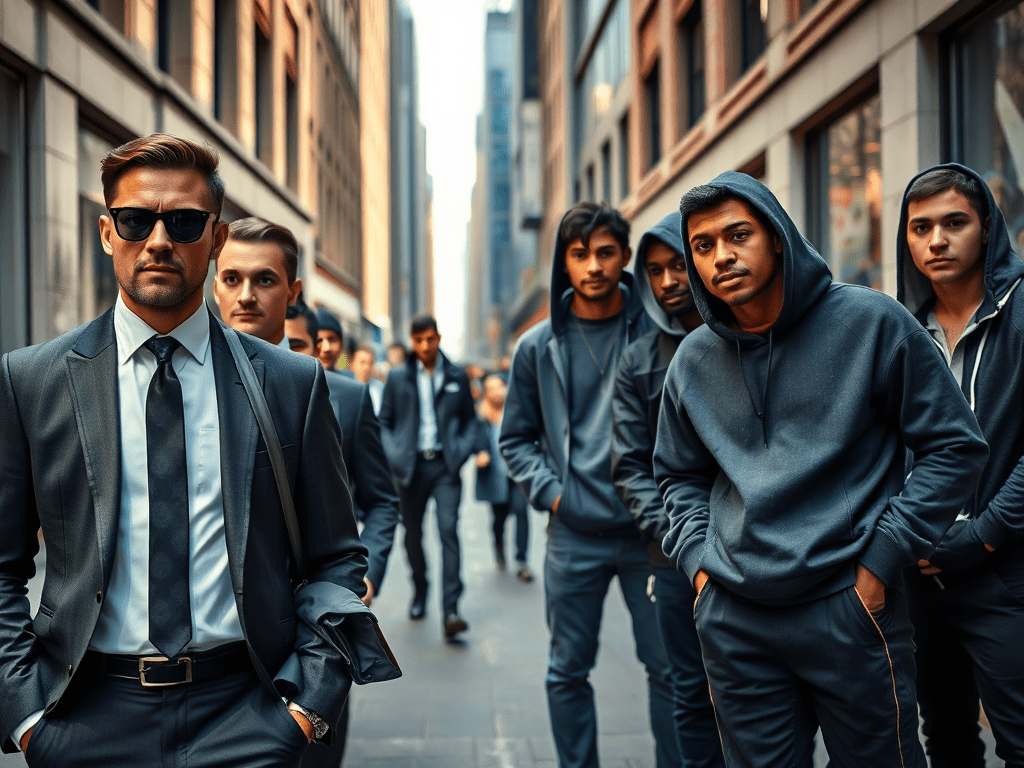
We live in a very materialistic world. How we dress defines what type of person we are. I say this because people stereotype and get a sense of idea on what type of person you are primarily by the way you dress. Here’s an example: you walk down Wall Street, what do you see? A large number of men wearing suits, your immediate assumption these are all wealthy men. You see another group of men in jeans and hoodies; your opinion of them may begin to deteriorate.

Why is it that we spend so much of our income on how we dress? What is the sole purpose of clothing? To regulate the temperature of our bodies(in which is why we wear coats in the winter), or is it to protects us from the environment that why we wear shoes on our feet(at least in the industrialized developed world); but yet people become obsessed with fashion to the point that they’ll spend their entire paycheck on one a shopping spree.

So what is the purpose of clothing? As I alluded to in my introductory paragraph, human beings use clothes as a form of identity. You recognize a doctor by his white trench coat, as you recognize a police officer by his blue, sometimes black uniform. We impose identities on people based on how they dress. A young man walks down the street, with sagging paint, wearing a do-rag, and it might come to mind that he is a hoodlum. Another man walks down the street wearing an Armani suit. We say to ourselves This person is wealthy and respectable. From my observation, clothes are used as a status symbol.

Yet is a pair of Air Jordans worth its 250$ price tag? Especially when you consider the amount of capital in labor(very little since it’s made by a laborer in China who gets paid a third of a U.S worker’s would) or the material input, which may not be more than 20$ dollars. I appreciate free market capitalism in which firms seek to make a profit, I get it. But at the same token some common sense has to prevail, as consumers we shouldn’t be so swept into spending our money(many of us work extremely hard for) just to wear the same iteration of sneakers that essentially hasn’t changed in design for 25 years and is purposely kept in low supply by Nike to jack up the price, to feel any type of self worth.

In society, many people(many times, typically from poor minority backgrounds) spend a great deal of their income on clothing, finding self-worth through keeping up with trends. This can be quite destructive, one can look at all the black who have been murdered just for a pair of 200$ sneakers. How a person living in public housing and substitutes on government assistance still finds the spare income to allocate towards a pair of jordans, yet some of the rich’s people in the world spend very little in thought or on income on the way they dress. The most famous is Mark Zuckerberg, the founder of Facebook, whose net worth as of 2016 stands at around 46 billion. He famously only wears a gray t-shirt, blue jeans, and Converse as his typical attire.

There is a serious need for dialogue on priorities when a tech billionaire spends less on clothing than your typical inner city young man.

Why Gender is not fully a social construct(part 1)

The argument has been made that gender is fully a social construct, with no biological merit. I want to argue against this point. First, I do acknowledge the fact that there are obvious cultural artifices in constructing how the two sexes behave. Pink is often associated with girls, while blue is typically linked to boys. Ashley is a girl’s name, and John is a boy’s name. These are all examples of gender norms established by society. But there is also a certain predisposition that is fully biologically based. Point one, men and women have varying degrees of hormonal differences. Men, on average, have far higher levels of testosterone than women, and women, on average, have far higher levels of estrogen. Our emotions and behaviors are heavily influenced by the chemicals in our brains. For example, higher levels of testosterone lead to a higher instance of aggression, assertiveness, and violence. Estrogen makes individuals more empathetic. The unequal distribution of these two chemicals among the sexes leads to differences in biological dispositions and behavior.

Many point out how Gender roles are socially based. But I want to argue that gender roles are a part of human evolution. Humans are a sexually dimorphic species, meaning there is a physiological difference between the sexes. Men are on average 3 inches taller and weigh 25% more than women. Nature doesn’t just make species sexual dimorphic unless there are some sexual survival benefits from it. Case in point, a book written by Leonard Shlain “Sex, Time, and Power”(A must read) Shlain( a surgeon) theorizes that because women on general suffer from Iron deficiency(due to the fact they lose blood every month from menstrual cycles, as well as their red blood cells produce less Iron), and the fact women have to go through eight months gestation and six years weaning a newborn child. Women needed men to help them attain Iron by providing them with meat; in return, the men got copulation.

For those (particularly feminists) who are skeptical about this. Imagine 150,000 years ago, living in the Savannah of East Africa, being a pregnant mother (let’s imagine 6 months), trying to go hunting. You would put yourself and your child at great risk. Sure, you would be able to go forging, but subsisting on local vegetation alone will not be enough for you and your gestating child. Men would have to go out and hunt while the women remained in the village. This arrangement would have existed for all of humanity until the emergence of civilization around 10,000 years ago.

With the beginning of civilization, humans transitioned from relying solely on wild game and vegetation to domesticating both crops and animals. Many of the roles that women had previously held remained largely unchanged, as women still became pregnant and had to care for their young children. Men now had to participate in the field or face starvation. We see the emergence of patriarchy in this time period. Men, having a physical advantage over women, took responsibility for keeping society safe from outsiders as well as undertaking all the intense labor required for agriculture.

Feminism as we know it wouldn’t become a serious ideology in Human affairs until the Industrial Revolution, for good reason. Humanity (at least in the West) wasn’t reliant on muscle power, but on stem and steel to grow its food. Women could go out to work. This new era of technological advancement is the only reason feminism was able to emerge!